




A small drone lifts off the grass, wobbles violently, and flips upside down. The child at the controls does not wait for a teacher to intervene. They immediately know what happened: they wired a motor backward.
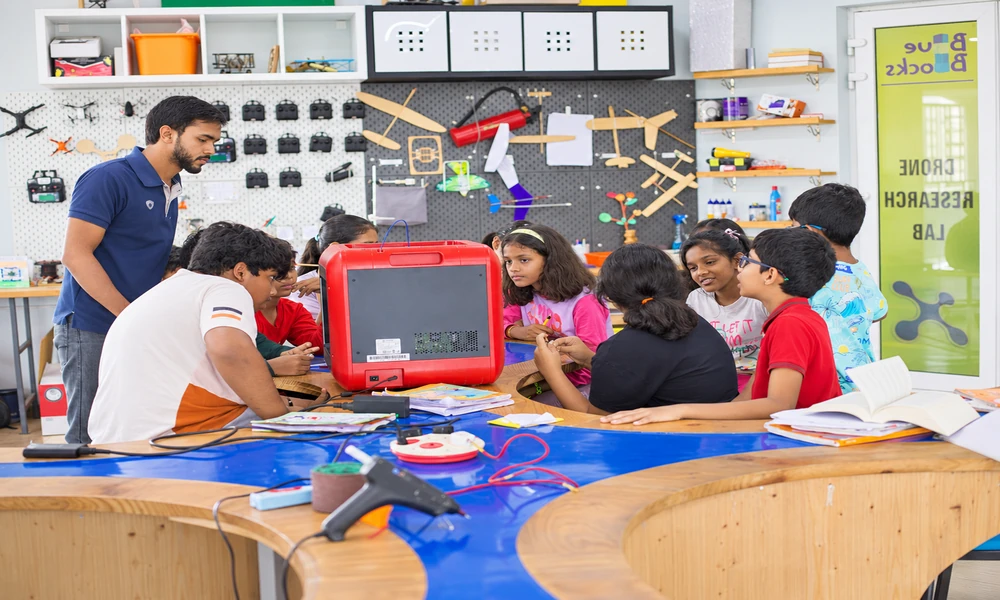
This visceral feedback loop is exactly how drone labs help students learn. A drone in a classroom takes abstract physics and coding and gives them immediate, physical consequences. At Blue Blocks Montessori School in Hyderabad, the student drone lab serves students from ages six through sixteen, with the work growing more complex alongside the child. A six-year-old might begin by learning the simple basics of flight, a twelve-year-old moves on to building working prototypes, and a sixteen-year-old uses drones to test satellite sensors at varying altitudes.
Across every stage, every line of code and every soldered joint is tested outdoors, forcing students to confront real engineering trade-offs. If a battery is too heavy, the motors cannot lift it. If a flight path is coded incorrectly, it does not produce a quiet error message on a screen; it produces a sudden crash in the grass.
What is the drone lab at Blue Blocks?
The Drone Lab at the school’s Tellapur campus brings aeronautics, electronics and responsible technology into practical work. Rather than a remote-control club, it follows a developmental progression from the principles of flight to more demanding designs. Families looking at a drone lab school hyderabad offers will find that the emphasis falls on building and understanding aircraft, not only on flying them.
A child can fly a ready-made drone without knowing what keeps it steady in the air. Building one raises different questions. Where is its centre of gravity? How do the motors, battery and controls interact? What happens when it meets a gust of moving air?
How do students learn drones in school?
Early builds use simple materials: ice-cream sticks, glue, small motors, propellers and an accelerometer. Working with exposed components lets children see how structure affects behaviour, because nothing is hidden inside a finished casing.
With experience, students investigate lift, drag, balance, battery weight and motor thrust. Older learners move on to circuits, sensors, calibration and programming, including Python code for planned flight paths.
A prototype tests each idea immediately. If an aircraft cannot lift its own mass, a bigger battery may make matters worse, since it adds weight as well as power. Students learn to identify the variable that matters, change one thing and test again. A child who changes the battery, propellers and frame at the same time may get a different result without knowing why. Changing a single factor, comparing the outcome and recording the decision produces an explanation rather than a lucky success.
The design and fabrication behind this work, from cutting a frame to modelling a part, draws on the school’s wider workshop, where drone training for school students hyderabad parents may be looking for becomes part of a larger engineering practice.
Looking backwards before building forwards
Before children build, the Drone Lab asks them to study a timeline of thirty inventions and consider what each one gave humanity and what it took away. The motor car widened mobility and added to pollution. The smartphone connected people and competed for their attention. Solving one problem can create another.
The exercise prepares children for a question every engineer eventually faces. The effects of an invention often appear far from the person who made it. A useful camera can intrude on someone’s privacy, and a helpful aircraft can disturb a nesting bird.
Four checks before every flight
That thinking carries into a routine the Drone Lab calls its Conscience Check, completed before any flight. The first check is privacy: where will the drone fly, and could its camera record people without their consent? The second is safety: what risks could it pose to people, property or wildlife? The third is ecology: could its noise disturb birds or insects, and how will batteries and damaged parts be handled? The fourth is purpose: is the flight necessary at all, and does its benefit justify the resources and risks?
The fourth question surprises many children. If an aerial view is meant to observe a vegetable bed, but walking across the garden would answer the question just as well, the drone may be unnecessary. Choosing not to fly is also an engineering decision.
Regulation adds a further layer. India divides its airspace for drones into green, yellow and red zones, and the rules depend on location and the type of aircraft. Adults check the applicable rules and supervise every flight. Children learn why the limits exist without carrying responsibility for legal compliance.
From exercises to ideas that serve people
The five patent applications addressed borewell rescue, medical assistance, essential deliveries, health monitoring and personal security. Each began with a human need rather than a technology looking for a use.
The borewell concept shows the difference. A conventional exercise might ask children to build a drone that flies. This idea started with a child trapped in a narrow shaft, which turned the task into a much harder problem: how could an aircraft enter a confined space and support a rescue? The application documents the proposed system. Like the other four, it is a filed application, not a granted patent or a working product, and its value for the children lay in carrying an idea all the way to formal technical documentation.
The same work now extends into practical contexts such as crop monitoring and terrain mapping, where cameras, sensors and data meet the needs of farmers and planners. Each context brings the same two questions back to the table. Will the mechanism work, and will it genuinely help the person it is meant for?
Building an aircraft and learning to fly one
Piloting courses develop coordination and operational discipline, and they have their place. A school drone lab adds something different: an investigation of the aircraft itself, from its frame to its code to its consequences.
For parents weighing up an innovation program school hyderabad families can visit, the most telling evidence is rarely a photograph of a drone in the air. Ask to see sketches, prototypes and test notes. Ask who supervises flights, what happens after a design fails and whether students can explain the privacy and ecological effects of their choices. A child who can explain why an aircraft was built the way it was has learnt more than one who can only fly it.
Frequently asked questions
Does my child need to own a drone to take part?
No. A school lab provides shared components, models and supervised equipment. Learning can begin with observing, building, measuring, and troubleshooting long before a child benefits from owning a ready-made aircraft.
Is a drone lab focused on coding or engineering? It focuses heavily on both. Children write autonomous flight code, but they also solder wires, measure payloads, calibrate sensors, and test aerodynamics. The drone only successfully flies when all of those disciplines come together. Can drone work at school lead to careers later?
It can open doors, but its main value at school is broader. The habits it builds, such as testing one variable at a time, documenting results and weighing consequences, apply equally in engineering, agriculture, environmental science, disaster response and research.
How can parents support an interest in drones at home?
Build simple flying models together, such as paper gliders or rubber-band planes, and change one feature at a time to see what happens. Talk about where drones are used around you, and ask your child who benefits from each use and who might be affected.
Deciding what deserves to fly
The best evidence of learning in a drone lab is not an aircraft in the air but a child who can explain its design decisions, its limits and its consequences. The aim is not only to teach children how to fly, but to help them decide what deserves to fly, and why.